Showing posts with label algebra. Show all posts

Wednesday, August 21, 2013

Using Algebra to Do Arithmetic


You can certainly do basic arithmetic like 12 times 28 without algebra, but it’s interesting that algebra can be utilized to make some arithmetic calculations more efficient. This can be really handy when you don’t have a calculator around (or when you don’t want to waste your cell phone battery for math), or if you take a test where a calculator isn’t allowed.

As one example, consider the algebraic expression (x + 1)(x – 1). When you foil this out, you get x2 + x – x – 1. The cross-terms vanish, leaving just x2 – 1.

Knowing that (x + 1)(x – 1) = x2 – 1 can actually be useful when doing multi-digit multiplication.

For example, consider 19 times 21. This is the same as (20 – 1)(20 + 1), which equals 202 – 1 or 399. It’s much easier to do 20 squared in your head than it is to work out 19 times 21.

Suppose you wish to multiply 26 by 34. You can write this as (30 – 4)(30 + 4) = 302 – 42 = 900 – 16 = 884.

Let’s try 13 times 17. You can turn this into (15 – 2)(15 + 2) = 152 – 22 = 225 – 4 = 221. Here, it helps to know the perfect squares of 11 thru 20.

The cross-term doesn’t always vanish, though. Consider 18 times 23. This becomes (20 – 2)(20 + 3) = 202 – 2(20) + 3(20) – 6 = 400 – 40 + 60 – 6 = 414.

As another example, 11 times 13 can be written as (10 + 1)(10 + 3) = 102 + 10 + 30 + 3 = 143.

When the cross-term doesn’t vanish, you’re probably not saving anything by using algebra – the usual arithmetic of 18 times 23 or 11 times 13 will be just as much work.

However, if you want to multiply 1001 times 1050, it may be simpler to write (1000 + 1)(1000 + 50) = 10002 + 1000 + 50000 + 50 = 1,051,050, provided that you’re good at counting the zeroes when you work with multiples of 10 and good at keeping track of decimal positions when you add (if not, the conventional method helps you stay organized).

Challenge yourself: Can you think of any arithmetic problems that would ordinarily be quite tedious, which algebra would make much simpler?

Chris McMullen, author of the Improve Your Math Fluency series of workbooks

Friday, June 7, 2013

Issues with Multiple Choice Tests in Algebra


Suppose that an algebra problem asks a student to solve an equation for an unknown. The goal of the problem is to test whether or not the student knows how to apply a particular algebraic technique.

However, if the question is multiple choice, the student doesn’t actually need to know how to solve the equation in order to determine the correct answer. The student could simply plug each answer into the equation to see which one works.

Example: 3x + 20 = 12x + 2.

(A) x = 1 (B) x = 2 (C) x = 3 (D) x = 4 (E) x = 5

A student could simply try each answer. Plugging in x = 1, it’s easy to see that 23 doesn’t equal 14. Trying x = 2, 26 = 26. The student already has the answer, but hasn’t done any algebra.

If the correct answer is (E), or if the student makes a mistake in the calculation, it will take longer, but in principle, a student can get the correct answer without doing any algebra.

If there are fractions in the answers, that makes the calculation a little more cumbersome. Many students prefer to avoid fractions, so this may deter students from avoiding the algebra.

Suppose that the choices had been:

(A) x = 1/2 (B) x = 18/15 (C) x = 22/15 (D) x = 2 (E) x = 22/9

Some problems can be solved faster by actually doing the algebra. But more time-consuming problems, like using the quadratic or solving a system of equations, might be solved faster by just plugging the answers into the original equations. When algebra yields the fastest solution, this provides an incentive to solve the problem as intended.

If a student relies on plug and chug for every problem, the student risks not finishing the test. But students probably won’t try to solve every problem this way. Just the hard ones.

Fortunately, there are many problems that tests can ask that can’t be solved this way. For example, many problems ask students to simplify an expression, and there are also conceptual, strategic, and logical questions. This helps to ensure that students must grasp some algebra concepts in order to pass the class.

The main goal of an algebra course is for students to become fluent in solving for unknowns in a variety of types of equations. Multiple choice is convenient, especially in large classes. It’s worth considering whether or not students might find ways to succeed in the course without actually mastering the techniques.

One way is for the instructor to become acquainted with the students, perhaps by checking written solutions of homework or quizzes (or adding a few written problems to exams, where feasible), helping students solve problems on the board, or interacting with students during office hours. If students who ordinarily struggle solving equations are better able to figure out the right answers on multiple choice problems, this might be a signal (of course, this could also be the result of studying, tutoring, and improvement). If instead experience with their written solutions corresponds well with their ability to solve similar problems on multiple choice exams, then there may not be any reason to worry that the students who most need to improve their fluency might be finding an easy way out (which may very well be the case for many of the students – it might be the clever problem-solvers who are most likely to think of this).

Chris McMullen, author of the Improve Your Math Fluency series of workbooks
Tuesday, March 12, 2013

Is Everything Really Just Nothing?


You might be inclined to wonder this with a little abuse of the transitive property.

The transitive property of mathematics states that if A = B and C = B, then it follows that A = C.

Let’s try to apply this to words and see where it leads.

Everything is something. Agree with that? (Really, it’s a whole lot of something’s.)

Let’s take everything to be A and something to be B. Then saying, “Everything is something,” is like saying A = B.

Nothing is something. Agree with this? (It’s just something that isn’t.)

Let’s call nothing C so that saying, “Nothing is something,” is the same as B = C.

If A = B and C = B, then C = A; that’s the transitive property.

Plug in the words: If everything = something and nothing = something, then everything = nothing.

Everything is nothing! What?!

Can you find the fallacy here?

Spoiler alert: The solution will be forthcoming. If you’re not ready to read the answer, don’t look below.

The problem isn’t with saying, “Everything is something,” or, “Nothing is something.”

The problem is that everything and nothing are two different something’s, not the same something.

In algebra, “Everything is something,” is like A = X and, “Nothing is something,” is like C = Y. The first something, X, isn’t the same as the second something, Y.

(Thinking of these “things” as numbers, you might want to write something like A = infinity and C = 0; both infinity and zero are something’s – as I said, that wasn’t the issue. The issue is more like the fact that infinity and zero are two different things.)

Really, in words, we should say, “Everything is something, but nothing is something else.”

Ain’t dat somepin’ else?

Chris McMullen, author of the Improve Your Math Fluency series of workbooks

Friday, February 8, 2013

Two Common Math Mistakes


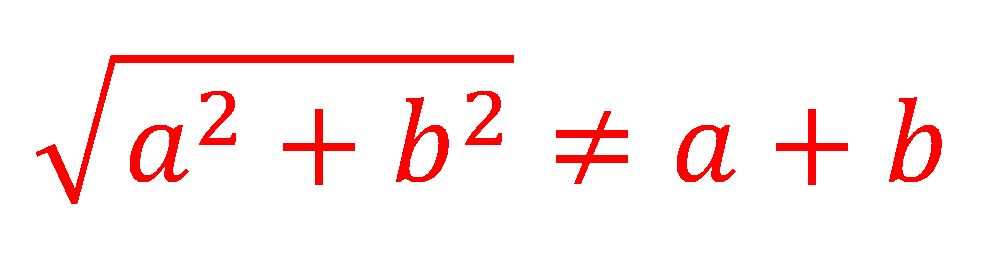
(1) Forgetting the Pythagorean theorem:


Here is an example with numbers:


There are two possible answers because the square of a negative number is positive:


Conceptually, the reason that the squareroot of (a2 + b2) doesn’t equal (a + b) relates to right triangles.  According to the Pythagorean theorem, a right triangle with sides a and b has a hypotenuse, c, equal to the squareroot of (a2 + b2).


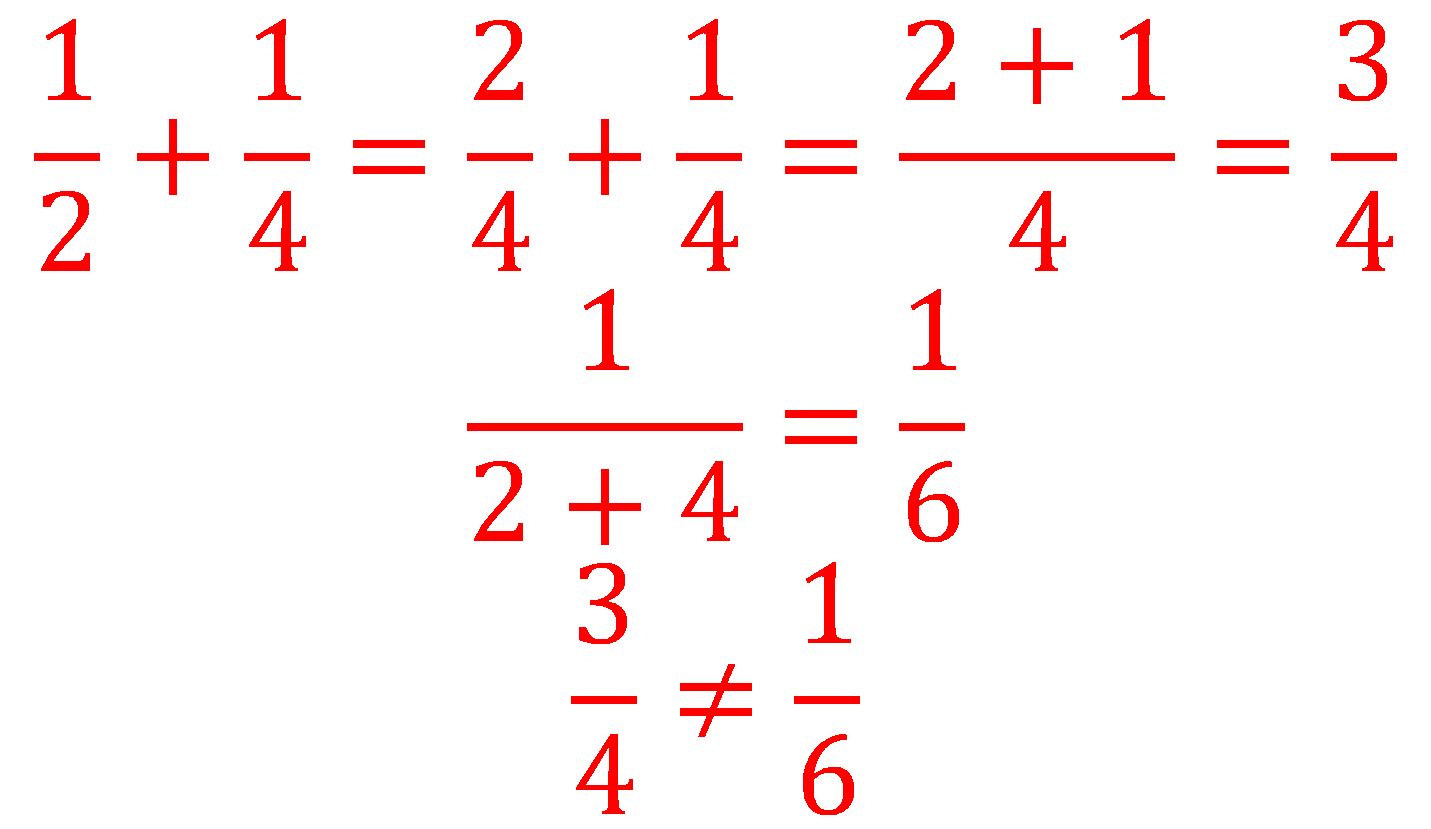
(2) Forgetting a common denominator:


Here is an example with numbers:


You can’t just ignore the numerators.  The way to add fractions is to first find a common denominator.  In the above example, 1/2 and 1/4 have a common denominator of 4, since 1/2 can be expressed as 2/4.  Once both fractions have a common denominator, you can add the numerators together.

Chris McMullen, author of the Improve Your Math Fluency Series